Know What Could Harm Your Business. Know Where to Act.
See Risk Management in Action
Watch a quick walkthrough to see how Trustero automatically collects, organizes, and maps evidence across your stack — so you can move from collection to control, faster.
Assess the Risks You May Be Missing. Evaluate the Controls You Are Relying On.
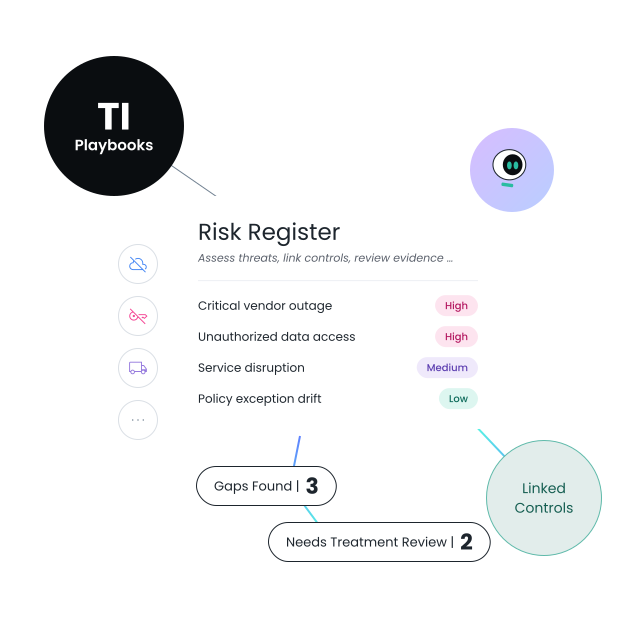
TI Playbooks help you examine relevant threats, potential adverse impacts, and gaps in your risk assessment. The Risk Register connects documented risks to the controls intended to mitigate them and their ongoing test results.
Together, they help you challenge both the completeness of your assessment and the evidence supporting your response.
Get to a Meaningful Risk Assessment Faster
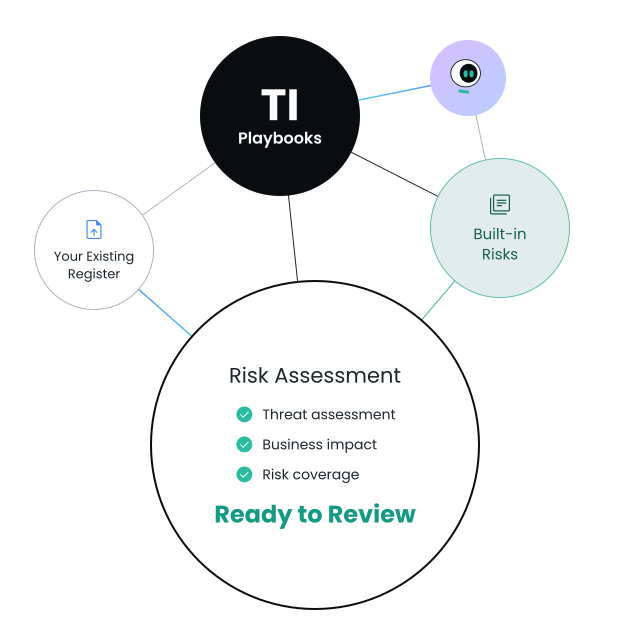
Start with built-in risks or bring your existing register into Trustero. Use TI Playbooks to work through threat assessment, potential business impact, and risk coverage without building every analysis from scratch.
Spend less time assembling the assessment and more time reviewing the results, making decisions, and addressing risk.
Strengthen Assurance With Evidence Behind the Assessment
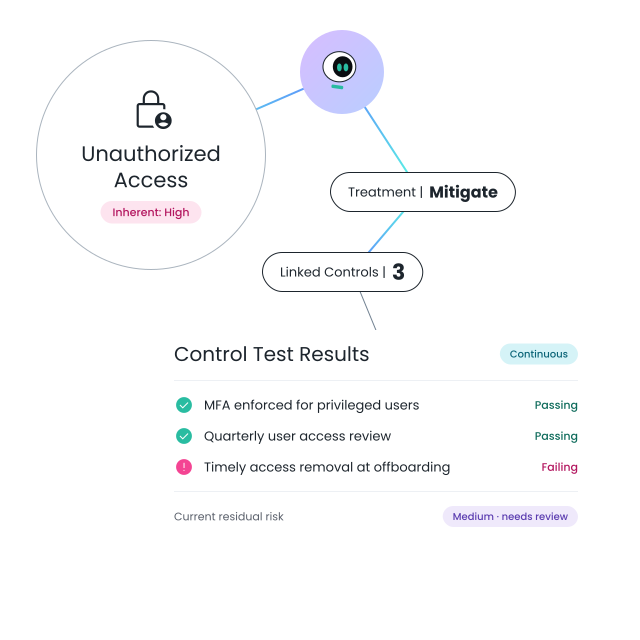
A documented treatment is not the same as evidence that a control is working.
Connect risks to the controls intended to mitigate them and review ongoing test results. As those results change, your team has current evidence to reconsider whether the treatment remains sufficient.
Go Beyond “Are We Compliant?” to “What Happens to the Business?”
Regulatory requirements remain important. But your risk assessment also needs to address the consequences of a service disruption, unauthorized access, a critical vendor failure, or another event that could affect the business.
TI Playbooks help your team examine relevant threats, assess potential adverse impacts, and compare those scenarios with what your risk register already covers. Understand what could go wrong, what it could affect, and where further assessment or treatment is needed.
| Priority and Page Message | What TI Playbooks Help Your Team Do | Why the GRC Buyer Should Care |
|---|---|---|
| 1 Understand the Business Consequences | Examine how an identified threat could affect assets, services, operations, customers, or business commitments using the context provided. | A “high” rating is not enough. Leaders need to understand what could be disrupted or harmed before deciding how much attention and investment a risk warrants. |
| 2 Assess Threats Relevant to Your Environment | Use business context, assessment scope, and available threat information to identify scenarios relevant to the organization. | The assessment can reflect the business being protected, rather than relying only on a generic risk list or regulatory requirements. |
| 3 Find Gaps in Your Risk Assessment | Compare relevant threats with the existing register and identify where coverage is present, partial, or missing within the assessment scope. | Teams can challenge whether important scenarios have been overlooked and identify where further analysis is needed. |
| 4 Focus Attention Where Treatment Needs Review | Review risk ratings, treatment targets, and linked control results to highlight items that need attention. | GRC teams can direct limited resources toward meaningful treatment gaps and give leadership a clearer basis for decisions. |
Keep the Assessment Useful Between Reviews
Schedule recurring Playbooks to review the risk portfolio, highlight changes in linked control results, and surface risks that need attention. Deliver the results through customized reports rather than rebuilding the analysis for every review meeting.
The value is not simply another automated report. It is less effort to keep risk decisions connected to changing evidence.
A Critical Vendor Goes Down. What Does That Mean for Your Business?
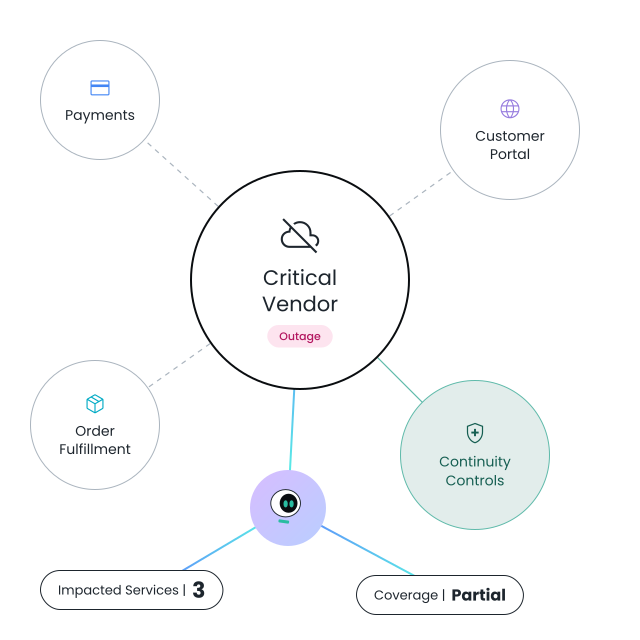
Recording “vendor disruption” as a high risk is a starting point. It does not explain which business services depend on that vendor, what an outage could interrupt, or whether the organization is prepared to respond.
Use TI Playbooks to examine the scenario against your business context, identify potential adverse impacts, and review whether the existing risk assessment adequately covers the dependency. Then connect the risk to relevant continuity controls and review the evidence supporting their operation.
The result: a more informed discussion about business consequences and treatment priorities, not simply another risk entry.

GRC Has Hit a Structural Breaking Point
The rules governing your business have multiplied by more than 500% since 2008. Your technology stack has grown more complex. Your vendor ecosystem now exposes you to thousands of fourth- and fifth-party risks. And your customers expect real-time compliance transparency — not an annual attestation.
Yet most GRC teams are still running the same manual processes they used a decade ago. Spreadsheets. Email chains. Quarterly control tests. Eight-week audit sprints.
This isn't a staffing problem. Hiring more people won't solve it. It's a systems problem — and the only viable solution is a fundamentally different operating model.
Multi-Agent AI for GRC: What It Is and Why It Changes Everything
Multi-agent AI is a coordinated system of specialized AI agents that reason, decide, and act autonomously to accomplish complex, multi-step objectives. Unlike a general chatbot — which responds to prompts — or a traditional GRC SaaS platform — which organizes human work — a multi-agent GRC system executes GRC functions directly.
Each agent is purpose-built for a specific task: testing controls, scoring vendor risk, closing policy gaps, managing evidence. Agents share context, coordinate across workflows, and operate continuously — without headcount constraints and without degrading at scale.
GRC is uniquely suited to this model. Compliance work is rules-based, repetitive, high-volume, and audit-sensitive. These are precisely the conditions where specialized AI agents deliver the most value. And because GRC obligations span every team in your organization — not just the compliance function — a system that embeds compliance intelligence across the entire business changes what's possible.
A GRC Intelligence Layer, Not Another Tool
Trustero AI is the first enterprise-grade multi-agent AI platform purpose-built for Governance, Risk, and Compliance. It is not a general AI tool adapted for GRC. It is not a traditional GRC platform with AI bolted on. It is a dedicated GRC intelligence layer that sits alongside your existing infrastructure — ingesting data, enriching it, and executing compliance work across your organization continuously.
At the core of Trustero AI is the Trust Graph: a continuously enriched knowledge structure that ingests GRC-relevant data from SaaS applications, on-premises systems, shared drives, and existing GRC platforms. Trustero's agents operate within constrained Trust Graph context — ensuring every output is accurate, consistent, and directly traceable to source data.
This architecture is what makes Trustero AI enterprise-grade. Not just capable. Compliant-by-design.
Start Fast. Make It Yours.
Start with a library of built-in risks aligned to common frameworks and threat scenarios, or bring your existing risk register into Trustero. Customize categories, ratings, and treatment options to match how your organization actually operates.
Combine built-in and custom risks in a single register, so you can identify gaps against your business scope and relevant threat information rather than starting from a blank page.