
Third-party risk programs often inherit complexity one step at a time. After an incident, a new questionnaire is added. A new approval is added after an audit finding. Another spreadsheet is created because the existing system does not capture a needed detail. Eventually, the process includes a lot of work without giving the organization one current, explainable view of the relationship.
The way out is not to automate every existing step.
The better approach is to rebuild the workflow around the decision the program needs to support: Can the organization use this third party, under what conditions, and with what level of ongoing oversight?
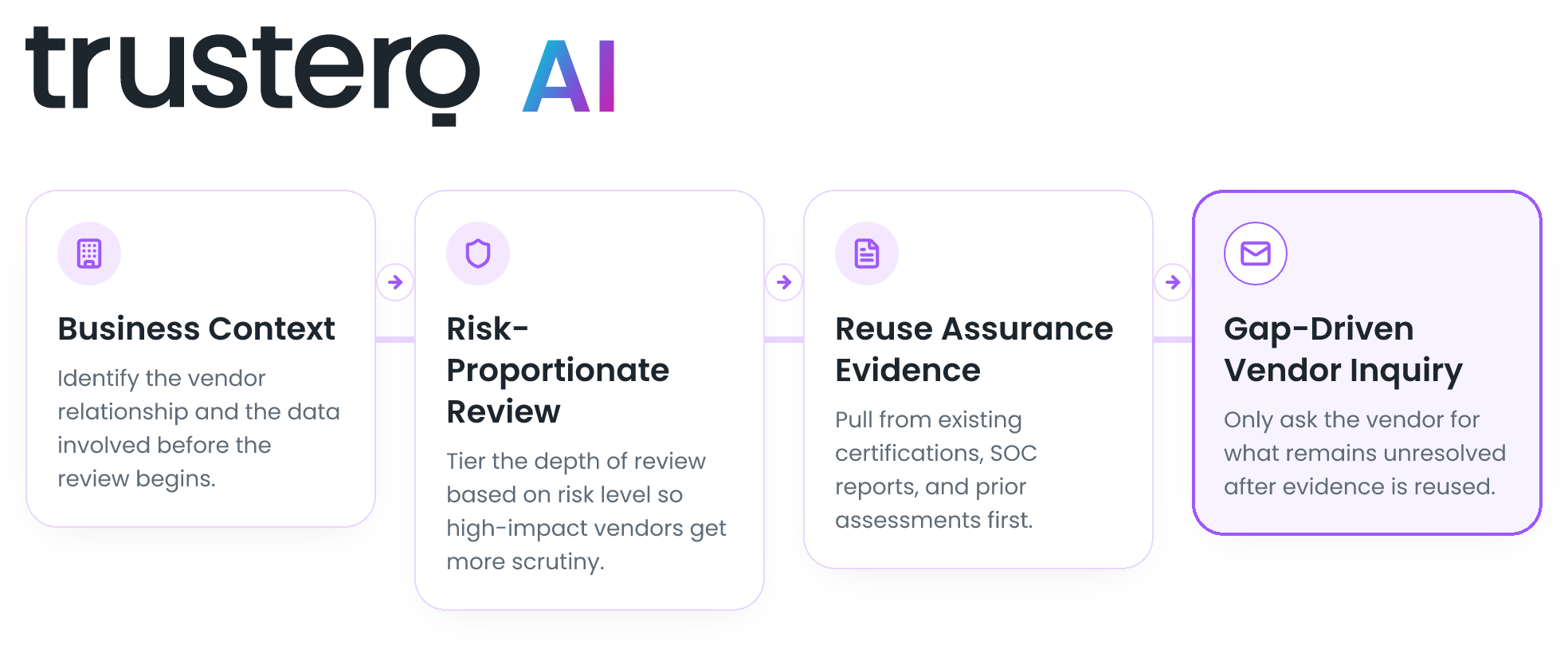
An evidence-first, gap-driven model answers that question through a connected sequence. It begins with business context, separates criticality from risk, matches due diligence to the relationship, evaluates available evidence before sending questions, preserves the decision rationale, and reassesses the relationship when material conditions change.
1. Define the boundaries before assessing the vendor
A risk process cannot consistently assess exposure until the organization has defined what falls within its boundaries. This includes the data, systems, business processes, organizational entities, geographies, facilities, and regulatory obligations that matter to third-party oversight.
The goal is not to create one universal definition of risk. It is to make the organization’s own decision criteria explicit.
For example, the organization should know which data categories it considers sensitive, which systems are critical, what types of access require additional review, and which business services are subject to continuity or recovery requirements. Without those definitions, different reviewers may assign different risk levels to similar relationships because each person is applying a different understanding of what matters.
The boundary definitions should be available to the intake, tiering, assessment, approval, and monitoring workflows. They should not remain trapped in a policy document that the operating process cannot use.
2. Capture the business relationship in plain language
The initial intake should ask the business owner for information they can reasonably provide. It should not require that person to perform the security or compliance assessment.
At a minimum, the intake should establish:
- What product or service the third party will provide.
- Which business outcome or process the relationship supports.
- Who owns the relationship internally.
- What information the vendor will receive, create, store, or process.
- Whether the vendor will access internal systems, infrastructure, or credentials.
- Whether an integration, privileged connection, or automated action is involved.
- How dependent the organization will be on the service.
- What would happen if the service became unavailable.
- Whether an alternative provider or manual process is available.
- Whether the relationship affects a continuity, recovery, contractual, privacy, or regulatory obligation.
These questions provide the operating context for everything that follows. They also help identify when the business owner lacks enough information to proceed.
The intake should remain connected to the vendor record. If the relationship later expands to a new data category, adds an integration, or becomes critical to another business process, update the original context rather than recreate it in a separate form.
3. Separate criticality, inherent risk, and residual risk
A common source of confusion is treating the risk tier as though it represents every dimension of the relationship.
Three concepts should remain distinct.
Business criticality describes how important the third party is to operations. It considers the impact of an outage, the availability of alternatives, recovery expectations, and what the Business Impact Analysis or Business Continuity Plan indicates about the dependent process.
Inherent risk describes the exposure created by the relationship before evaluating the vendor’s controls or other mitigating factors. Relevant considerations may include sensitive-data processing, internal-system access, privilege, integration depth, decision influence, operational dependency, geography, and applicable obligations.
Residual risk is the risk that remains after the organization evaluates the vendor’s controls, available assurance evidence, contractual protections, remediation, and accepted exceptions.
A business-critical vendor may have strong controls and low residual security risk while still remaining critical to the organization’s operations. Conversely, a vendor may not be operationally critical but may still create meaningful privacy or security risk because of the information it processes.
The risk model should preserve these distinctions. Otherwise, a single score can hide the reason the organization needs oversight.
4. Let the tier determine the due-diligence plan
The risk tier should determine the depth of review, not merely the label attached to the vendor.
A lower-risk relationship may require basic ownership, service, data-use, contractual, and assurance information. A higher-risk relationship may require deeper review of security, privacy, resilience, incident management, access control, concentration risk, and recovery.
The organization should define the review requirements for each tier before individual assessments begin. This improves consistency and allows reviewers to explain why one vendor received a deeper assessment than another.
The tiering logic should also be explainable. A reviewer should be able to see which factors drove the recommendation and change the result when the business context is incomplete or unusual. A hidden score that cannot be interpreted is difficult to defend and difficult to improve.
The person responsible for the decision must be able to approve, modify, or reject a recommended tier. Automated tiering can organize defined factors, but it does not replace risk appetite or qualified judgment.
5. Review available evidence before sending a questionnaire
Once the organization understands the relationship and applicable requirements, it can determine what evidence is already available.
The vendor may provide policies, independent audit reports, certifications, attestations, testing summaries, privacy documentation, recovery information, architecture descriptions, subprocessor information, or other material through a trust portal or assurance package.
The reviewing team should evaluate that evidence against the requirements that apply to the relationship.
The objective is not to count documents. It is to determine what each source actually supports.
For every relevant requirement, assign a review status:
Status
Meaning
Typical next action
Supported
Current, in-scope evidence directly addresses the requirement
Record the source and reviewer conclusion
Partially supported
The evidence addresses part of the requirement but leaves a material question
Ask a targeted follow-up
Stale
The evidence may have been useful but no longer covers the needed period
Request a current source or compensating information
Conflicting
Two sources appear to provide inconsistent information
Investigate and resolve the conflict
Missing
No suitable evidence has been identified
Request evidence or an explanation
Not applicable
The requirement does not apply to the relationship
Record and approve the rationale
This status model creates a repeatable review process. It also makes the next action visible.
Do not accept an independent report simply because it exists. The reviewer should examine the scope, covered services, entities, locations, report period, qualifications, exceptions, complementary responsibilities, and whether the report actually relates to the service the organization will use.
The same principle applies to policies and certifications. The source must be current, relevant, and connected to the requirement being evaluated.
6. Turn unresolved gaps into targeted questions
After the evidence review, the organization should know what remains unanswered.
Those gaps—not a generic questionnaire—should drive the request sent to the vendor.
A useful follow-up question should explain the service or risk in scope, identify what the available evidence did not establish, and ask for the information needed to resolve the concern.
For example, instead of asking: Do you have a business continuity plan?
Ask: For the service in scope, what recovery objective applies, when was the recovery process last tested, and what evidence is available from that test?
Instead of asking: Do you encrypt customer data?
Ask: For the customer data processed by this service, where is encryption applied in transit and at rest, and are there any material exceptions?
Instead of asking: Do you review user access?
Ask: For privileged access to the systems supporting this service, what population is reviewed, how frequently is the review performed, and what evidence demonstrates completion and exception follow-up?
The second version of each question is more likely to produce information that a reviewer can evaluate. It connects the question to the actual concern instead of inviting a broad yes-or-no answer.
This approach also improves the vendor experience. The vendor receives a smaller set of relevant questions rather than another request to restate its entire security program.
7. Preserve the complete risk decision
The end of the assessment should produce more than a score or approval status.
The vendor record should preserve:
- The business purpose and relationship owner.
- The data, system, and operational exposure.
- The criticality and tiering factors.
- The evidence reviewed and the applicable period.
- The requirements that were supported, partial, stale, conflicting, missing, or not applicable.
- The vendor’s responses to targeted follow-up.
- Open findings and required remediation.
- Contractual or operational conditions.
- Accepted exceptions and the approving authority.
- The residual-risk conclusion.
- The next review date and material-change triggers.
- The person who made the final decision.
This information forms the basis for a defensible conclusion. It also gives future reviewers a starting point.
The reasoning should be understandable without reconstructing the assessment from email threads, spreadsheets, and disconnected attachments. Another qualified person should be able to see what was considered, what remained unresolved, and why the relationship was approved, conditionally approved, rejected, or escalated.
8. Monitor changes that can alter the decision
An annual reassessment date should not be the only reason to revisit a third party.
The organization should define events that can materially change the risk picture. Examples include:
- The vendor begins processing a new category of data.
- The relationship gains access to another system or credential.
- The service becomes more important to operations.
- A current attestation or report expires.
- A material incident or control finding occurs.
- A remediation deadline is missed.
- The vendor changes ownership or introduces a material subprocessor.
- The service, architecture, contract, or recovery commitment changes.
- The business owner expands the use case.
- The organization no longer has a viable alternative provider.
A material change should trigger the appropriate level of reassessment. It should not automatically require repeating the entire process.
The same connected record should support offboarding. Access must be removed, integrations disabled, data returned or deleted as required, contractual responsibilities completed, retained evidence preserved, and ownership closed. The lifecycle does not end when the contract is canceled; it ends when the remaining exposure has been addressed.
A practical example: assessing a payroll provider
Consider an organization evaluating a new payroll provider.
The initial intake establishes that the vendor will process employee identity, compensation, tax, and banking information. The service will integrate with the HR system and will be required to pay employees on time. The relationship therefore creates both sensitive-data exposure and material operational dependency.
The organization treats business criticality and inherent risk as related but distinct. The inability to process payroll drives criticality. The data categories, system integration, and financial activity drive inherent risk.
Based on those factors, the relationship receives a higher level of due diligence. The team reviews the vendor’s independent assurance report, security and privacy material, incident procedures, recovery documentation, and relevant contractual terms.
The assurance report supports several internal requirements, but its period does not include the vendor’s most recent platform change. The recovery documentation describes a plan but includes no evidence from the latest test. The available privacy information does not clearly explain retention after contract termination.
Those three gaps become the follow-up request.
The organization does not ask the vendor to answer every security question again. It asks for information about the platform change, recovery test, and post-termination retention. The reviewer evaluates the response, records two contractual conditions, and recommends approval subject to completion of a recovery-related action.
The final record explains why the vendor is critical, which risks were evaluated, what evidence supported the decision, which condition remains open, who approved the relationship, and what event would trigger reassessment.
That is a risk decision. A completed questionnaire alone would not provide the same context.
Where specialized GRC agents can help
Specialized GRC agents can support the repetitive, information-intensive work in this model.
An agent can help organize intake information, identify missing business context, evaluate defined tiering factors, extract relevant statements from approved documents, compare evidence with applicable requirements, classify gaps, prepare targeted questions, and summarize changes for review.
Each output should remain tied to its source. The reviewer should be able to inspect the evidence, understand the rationale, and modify or reject the proposed result.
Agent activity should also become part of the durable vendor record. A conclusion trapped inside a chat session is less useful than a source-supported finding connected to the requirement, evidence, reviewer action, and final decision.
Qualified people remain accountable for the material judgment. They determine whether the tier is appropriate, whether the evidence is sufficient, whether a gap changes the decision, whether an exception is acceptable, and whether the organization can proceed.
A practical starting sequence
Organizations do not need to redesign the entire TPRM program at once.
Start with one representative class of vendors and document the decision the process needs to support. Define the minimum business intake, the tiering factors, the evidence required for each tier, the evidence-review statuses, the approval record, and the events that trigger reassessment.
Then test the workflow against several real relationships.
Look for points where reviewers still leave the system to find context, where vendors are asked to restate available information, where two people interpret the same evidence differently, and where the reasoning behind a decision disappears after approval.
These problems show where the operating model needs clarification and where bounded automation can add value.
Trustero’s AI-native GRC approach combines organizational context, guardrails, specialized GRC agents, evidence-supported outputs, and explicit human decision rights. In TPRM, the opportunity is to help keep relationship context, tiering, evidence, gaps, decisions, and change connected while directing qualified people toward the work that requires judgment.
The goal is not to complete more questionnaires.
It is to make better third-party risk decisions with less unnecessary work and a clearer basis for saying yes responsibly.