
Policies describe what an organization expects to happen. They establish responsibilities, boundaries, and intended outcomes, but they do not, by themselves, explain how work moves across systems, where decisions are made, what evidence is created, or how exceptions are handled. That distinction matters because control design sits between policy intent and operational reality. A control copied directly from policy language may be too broad to perform or test consistently, while a control based only on current practice may simply preserve an existing weakness. Good control design requires both perspectives. It starts with how the organization actually operates, then asks whether that process addresses the intended risk and requirement.
Policy language is only the starting point
Consider a policy requiring system access to be removed promptly when an employee leaves the organization. The expectation is clear, but the operating process may be less straightforward. A change in employment status may begin in the human resources system, trigger an action in an identity platform, create a service ticket, and notify an application owner. Some systems may support automated deprovisioning, while others may require a manual step, and exceptions may need separate approval and additional monitoring. A control that simply states, “Access is removed when employment ends,” does not describe enough of the process to evaluate it reliably.
The control designer still needs to determine what starts the process, which systems and populations are in scope, who is responsible, how quickly each action must occur, what happens when the normal process fails, and which evidence demonstrates completion. Those details turn a general policy expectation into an operating control. Without them, the organization may have a well-intended control statement that is difficult to perform consistently and even harder to test.
The handoffs reveal the real control
The most important parts of a control often appear at the handoffs between people and systems. The HR system may be treated as the source of truth, but the access-removal process also depends on whether downstream systems receive and act on that information. A completed service ticket may show that someone performed a task, but it may not prove that access was removed from every in-scope application. The control therefore exists not only in the written requirement, but also in the sequence of events, responsibilities, system actions, approvals and exceptions that produce the intended outcome.
This is where control design can break down. The documented control may describe the expected result without reflecting the actual sequence of actions required to achieve it. Designing the control only from the policy can miss operational handoffs, manual dependencies, or systems that fall outside the standard process. Designing it only from the existing workflow can overlook populations, exceptions, or risks that the process does not currently address. A stronger approach compares the intended requirement with the operating process. The differences become design questions that a qualified GRC professional can investigate and resolve.
AI can support the design process
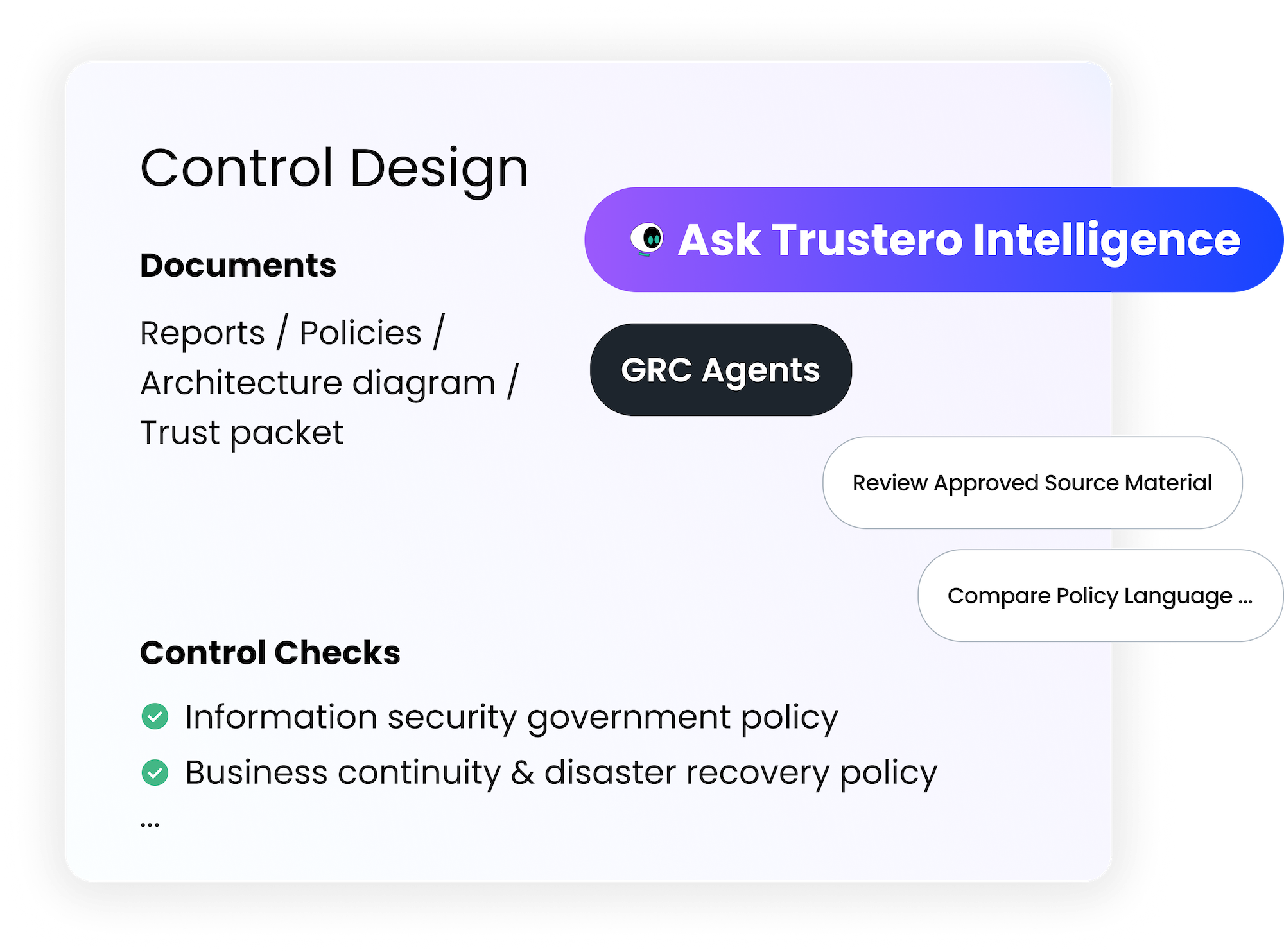
Understanding the operating environment can require interviews, process documentation, system inventories, existing controls, prior evidence, and input from control owners. Specialized GRC agents can support that work by reviewing approved source material, comparing policy language with documented procedures, organizing operational context, and identifying inconsistencies or missing information. They can also help prepare a proposed control statement and test approach for review.
“This changes the practitioner's starting point. Instead of drafting from a blank page or copying generic control language, the practitioner begins with a proposal connected to the organization’s actual systems, workflows and available evidence.”
The proposal still requires human judgment. Source material may be incomplete, a documented procedure may not reflect current practice, and an existing workflow may fail to address the risk. A suggested control may also be difficult for the business to operate or impossible to test with the available evidence. A qualified GRC professional must decide whether the proposed design addresses the risk, reflects applicable requirements, establishes clear ownership, and can be performed and tested consistently. AI can help bring the relevant context together and identify questions that deserve attention. It should not make the final control decision.
Better design produces better evidence
Control design affects every step that follows it. When a control clearly defines its scope, trigger, owner, frequency, expected action and exception path, evidence requests become more precise. Control owners better understand what they need to provide, and reviewers can apply a test procedure that is observable, evidence-linked, and explicit about what constitutes a pass or failure. The relationship between the requirement, control, evidence, test, result and follow-up action becomes easier to understand and defend.
Better control design also reduces the amount of interpretation required during testing. Instead of asking a reviewer to reconstruct how the process should have worked, the control itself establishes the expected operating sequence and the evidence that should result from it. When an exception occurs, the reviewer can see where the process departed from the design, who was responsible for follow-up, and whether the issue was resolved. That traceability helps another person understand not only what the control says, but also how it operates, how it was tested and why the conclusion is defensible.
Trustero applies organizational context, guardrails and specialized GRC agents to defined control-design and assurance work. The objective is to reduce repetitive preparation, surface design gaps earlier and give qualified practitioners a more complete basis for decisions that still require human judgment. The meaningful shift is not from people to AI. It is from designing controls in the abstract to designing them with enough operational context to be performed, tested, and defended.