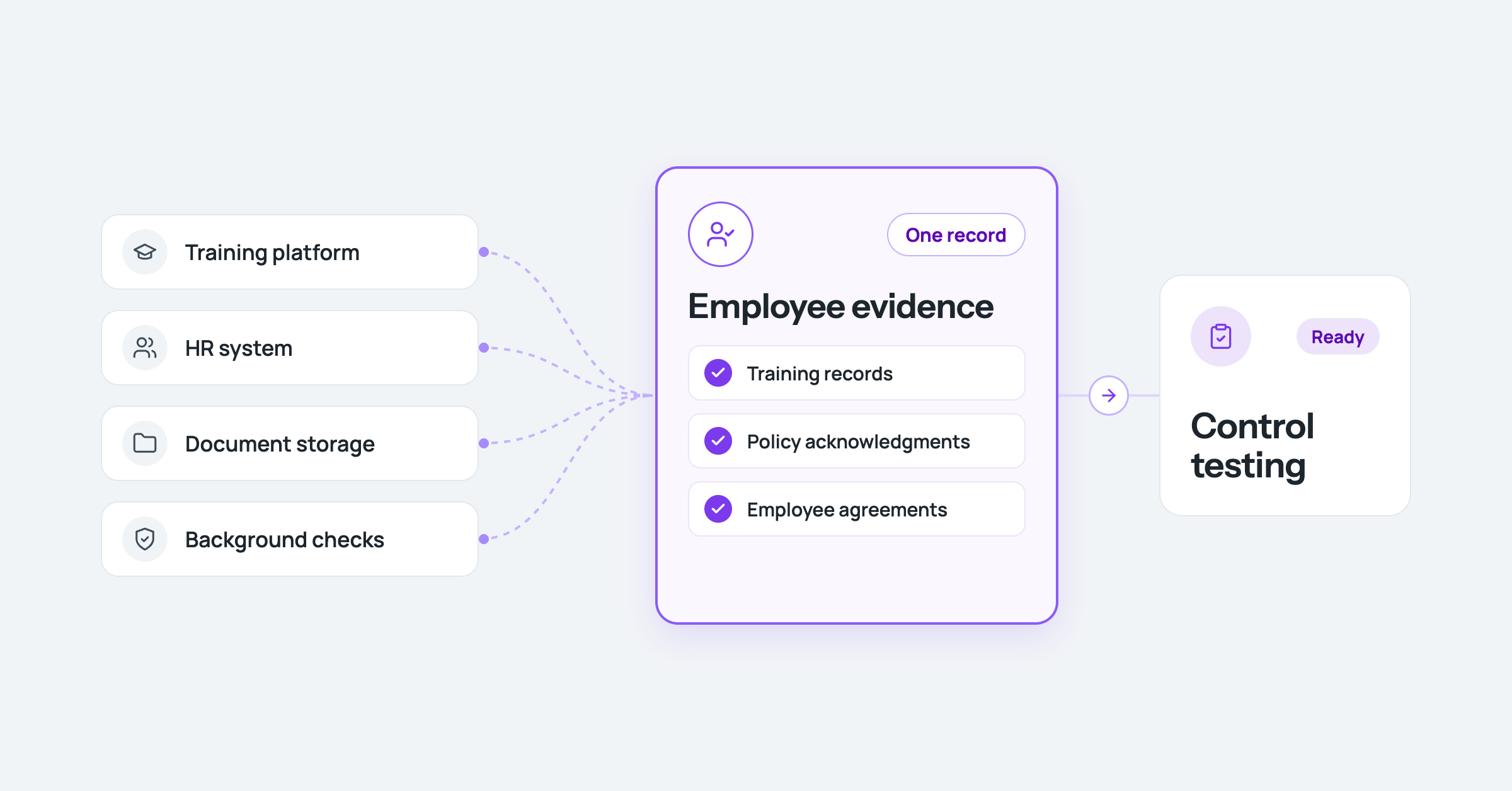

An HR department can have a system for every employee obligation and still struggle to answer a straightforward compliance question: has each person completed what is required, on time?
The answer may be spread across a training platform, an HR system, shared document storage, and a background-check provider. When compliance or internal audit requests evidence, someone must retrieve the records, reconcile them, and determine what they show.
Disconnected systems create extra work at this step. The opportunity is to connect their evidence without forcing HR to replace the tools it uses and make that information usable for control testing, rather than another spreadsheet someone has to maintain.
Each system holds only part of the picture
Consider an illustrative HR workflow. KnowBe4 tracks information security training. BambooHR holds employee policy acknowledgments and agreement sign-offs. Google Drive contains employee handbook acknowledgments, while a separate provider manages background-check records.
Each source serves a purpose. But HR needs to establish whether an employee has completed several different obligations. Training completion does not establish that an employee signed an employment agreement, and a signed handbook does not show that required training was completed before its deadline.
The fragmentation also affects who can answer the question. HR may manage employee agreements, security may administer training, and another owner may coordinate background checks. A compliance inquiry can therefore involve several people and several applications.
The organization needs a view across those sources: a reliable connection between the requirements being evaluated and the evidence showing whether they were fulfilled. Adding another system for managing employee activities would not provide that view on its own.
Manual extraction turns testing into a reconciliation project
For a manual review, the work can begin with separate exports and document requests. Someone then has to match records to employees, check dates, identify missing items, and follow up with the appropriate owner. Before testing the control, the evidence must be assembled into something testable.
One customer described relying on spreadsheets for HR-related compliance without a clear picture of whether policy sign-offs and training were being completed on time. With documents in different places, the team could not see with confidence which obligations were complete and which needed attention.
Repeating that process for every review consumes time without necessarily improving the underlying connection between systems. New employees, revised policies, and additional training cycles create more records to reconcile. The spreadsheet becomes one more file someone has to update by hand to link the source systems to the compliance question.
Reducing this repetitive work lets HR and internal audit spend more time investigating unresolved requirements and less time reconstructing the evidence needed to find them.
Connect the evidence around the requirement
A stronger approach starts with the control being evaluated. Define who is in scope, what they must complete, the applicable deadline, and what evidence would demonstrate completion. Then identify the source that holds each piece of information.
For the illustrative workflow, that could mean connecting training-completion records, policy acknowledgments, signed agreements, and handbook sign-offs to the applicable employee population. Each HR process can stay in its current application. The purpose is to make relevant evidence available for a common testing workflow.
The employee population is especially important. A folder of signed handbooks shows whose acknowledgment is available; it does not establish who should have signed but is missing. Comparing those records with the appropriate population allows the review to look for absence as well as completion.
Receptors connect source systems to the evidence platform. Each connection needs to bring in the context required for testing along with the documents. Employee identifiers, completion dates, and document versions may matter as much as the files themselves.
Collection should also stay focused on the control. For a background-check requirement, for example, the team should specify what evidence is necessary rather than assume the entire underlying report needs to be ingested. More data is not automatically better evidence.
Connected records still need verification
Once the records are together, the testing question becomes more specific: does the available evidence show that the relevant employee met the defined requirement? Answering that requires more than confirming that a file exists.
A training record may show completion but also show that it occurred after the deadline. A handbook acknowledgment may relate to a different version from the one under review. An unmatched record may reflect a data issue rather than an employee who failed to complete an activity.
Missing evidence also needs to be distinguished from demonstrated noncompliance. The testing workflow should make clear when a requirement is supported, when the evidence shows an exception, and when the result cannot yet be determined. Ingesting a record should not automatically produce a passing result.
AI-supported analysis can assist with defined comparisons and flag items for review. HR and audit professionals still need to validate the testing criteria, examine supporting evidence, and decide how to handle exceptions. Those decision rights keep broader testing accountable.
The objective is a clearer answer across the controls in scope. Connecting the systems does not by itself show that every HR obligation has been satisfied.
Use receptors to spend less effort on collection and more on follow-up
This is the evidence-collection problem Trustero’s receptor approach addresses. Trustero’s engineering team can develop source-specific receptors to ingest relevant evidence into the platform, subject to the source system’s available data and access. For workflows involving systems such as BambooHR, KnowBe4, and Google Drive, each connection should be scoped and validated against the evidence needed for testing.
The aim is to let HR retain its operational systems while giving HR, compliance, and internal audit a connected basis for evaluating controls. Instead of repeatedly extracting evidence from each application, teams can bring relevant records into a shared review and testing workflow.
Trustero’s evidence-supported approach connects that information to defined control testing, with qualified people retaining authority over material conclusions. Teams can then see what the evidence supports and where follow-up is still necessary.
For HR, that can mean more focused attention on outstanding acknowledgments or training requirements. For internal audit, it means a clearer basis for examining coverage, exceptions, and the evidence behind a result. The business case should be measured in reduced reconciliation work and answers teams can act on.
HR can keep each obligation in the application that manages it today, as long as it has a reliable way to connect the evidence and explain what that evidence says about its controls.